
A supplier offers Licochalcone A at 95% assay. The quotation looks clear enough, until the regulatory team asks for the documents behind the figure. Which test method was used? What does the percentage refer to? Does the specification describe the exact grade being purchased?
These questions tend to surface during supplier qualification, when changing a raw material or preparing a new formulation for the European market. Sorting them out early can save time later.
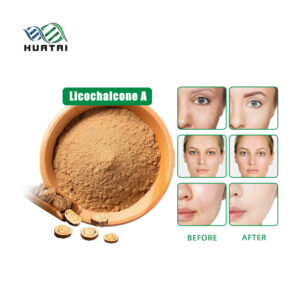
Licochalcone A is a licorice-derived chalcone used as a cosmetic ingredient. For an EU project, its identity and the documentation for the supplied material need to be reviewed alongside the requirements that apply to the intended cosmetic use. A supplier’s assay result is only one part of that review.
Start with the substance, then check the legal text
Searching for Licochalcone A in the European Commission’s CosIng database can help confirm ingredient naming and locate relevant reference information. The database should not, however, be treated as a list of ingredients approved for every cosmetic use. The Commission itself states that CosIng has no independent legal value.
The binding requirements are set out in Regulation (EC) No 1223/2009 and its applicable amendments. Annexes should be checked where relevant, including Annex III, which lists substances subject to restrictions. Any relevant Scientific Committee on Consumer Safety (SCCS) opinion may provide additional scientific context, but an opinion and a legal restriction are not the same thing.
A useful compliance record therefore identifies the substance searched, the official sources consulted, the provisions reviewed and the date of the check. A screenshot of a database result, without that context, leaves room for interpretation.
It is also worth keeping the question narrow. A search result alone does not establish that a particular commercial grade is suitable for a proposed use, nor does it replace the safety assessment required for the finished cosmetic.
The assay figure needs a paper trail
Huatai’s Licochalcone A range includes 20%, 70% and 95% grades. Those figures distinguish the commercial grades, but they should not be used interchangeably when reviewing documentation.
Ask the supplier to state what the assay percentage represents and how it is determined. The specification should identify the relevant test method and acceptance criteria. The certificate of analysis (COA) should then report the result for the actual batch supplied, using the stated method or a clearly explained alternative.
If the ingredient is supplied as a preparation rather than as a single high-assay material, the balance of the composition may matter to the formulator and safety assessor. A grade name alone will not answer that question. Where the available documents do not make the composition clear, request clarification before the material enters development.
The technical data sheet, COA and safety data sheet serve different purposes. One describes the material and its intended technical handling; another records batch results; the safety data sheet addresses relevant hazards and safe handling. None should be assumed to cover every question raised by the others.
A broad statement such as “EU compliant” is difficult to evaluate unless it identifies the grade concerned and the basis for the statement. Ask which requirements were reviewed and which supporting documents are available. That produces a more useful record than a general declaration.
A missing document is not always the same problem
During supplier review, a missing item should be assessed according to what it is meant to establish. An unclear description of colour may be a specification issue. Unexplained composition, inconsistent batch results or missing information needed for a safety assessment can have more serious consequences.
The distinction matters when comparing grades. Documentation for a 95% material should not automatically be treated as documentation for the 20% or 70% grade. Their specifications and composition may differ, and those differences need to be reflected in the assessment.
The same care applies after the raw material reaches the laboratory. An assay result does not predict how the ingredient will behave in a particular serum, cream or other formulation. Solubility, compatibility and stability need to be checked under the intended formulation conditions. Those tests address formulation performance; they do not replace the regulatory review.
Where the supplier’s responsibility ends
Under the EU Cosmetics Regulation, the responsible person must ensure that the finished cosmetic complies with the applicable requirements. A cosmetic product safety report must be completed before the product is placed on the market, and the product information file must be maintained as required.
Raw-material suppliers contribute information that supports this work. The final safety assessment, however, concerns the finished product and its full formulation, exposure and intended conditions of use. A supplier’s document package cannot establish the safety of every formula in which an ingredient might be used.
For a Licochalcone A project, it is practical to keep three records together: the regulatory check for the substance, the specification and batch documents for the selected grade, and the formulation-specific assessment. If the grade changes, review whether the existing documentation still describes the material being used.
That approach makes supplier comparisons more concrete. Instead of relying on an assay percentage or a general compliance statement, the development and regulatory teams can see which questions have been answered and which still need follow-up.
References
- European Parliament and Council. Regulation (EC) No 1223/2009 of 30 November 2009 on cosmetic products. Official Journal of the European Union. EUR-Lex.
- European Commission. CosIng: Cosmetic Ingredients Database. Directorate-General for Internal Market, Industry, Entrepreneurship and SMEs.
- European Commission. Scientific Committee on Consumer Safety (SCCS): Opinions and Guidance. Directorate-General for Health and Food Safety.

 English
  Spanish
  German
  French
  Japanese
  Korean