Your brightening serum turns yellow after three months. Or you find tiny crystals at the bottom of a sample batch.
Marketing materials often ignore these formulation realities. As the manufacturer Shaanxi Huatai, we see formulators struggle with this daily. Let us look at the actual physical and chemical behavior of this licorice root extract. No fluff. Just raw data and strict science.
The Reality of Color Shifts and Crystallization
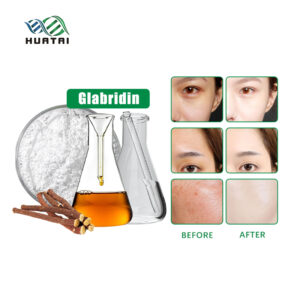
Glabridin is highly hydrophobic. Its LogP value sits around 3.5. This means it hates water.
A high-purity 90% extract is a white or off-white powder. It looks perfect in a clear serum. But it presents a strict solvent requirement. You must use glycols or alcohols. What happens if the water-to-glycol ratio is wrong? Crystallization. When shipping temperatures drop, poorly solubilized powder crashes out of the formula.
Many suppliers push expensive liposomal modifications to fix this. Modified delivery systems drive up your raw material costs. You do not always need them. Before paying that premium, test a robust solvent matrix. Using Butylene Glycol (BG) and Dipropylene Glycol (DPG) at a 1:5 ratio to the active often stabilizes the formula completely.
Why does it turn yellow? Photo-oxidation. The molecular structure contains phenolic hydroxyl groups. UV light and oxygen attack these groups. To stop the yellow shift, you must add antioxidants like 0.1% Sodium Metabisulfite or Tocopherol to your water phase.
The Mushroom Tyrosinase Trap
How does it actually perform against dark spots? We look at IC50 values. Lower numbers mean stronger inhibition.
Most marketing sheets compare this licorice extract to Kojic Acid using mushroom tyrosinase data. We must be rigorously scientific here. Mushroom tyrosinase is an in-vitro screening tool. It does not perfectly mimic human skin melanocytes. Here is the strict benchmark data comparing mushroom tyrosinase inhibition:
| Active Ingredient | IC50 (Mushroom Tyrosinase) | Source Type |
|---|---|---|
| Glabridin (90%) | 0.43 to 1.25 µM | Plant Extract |
| Kojic Acid | 9.40 to 14.8 µM | Fermentation |
| Arbutin | 50.0 to 65.0 µM | Synthetic/Plant |
While the in-vitro data shows superior potency over Kojic Acid, human skin penetration alters actual efficacy. You must formulate with penetration enhancers like DMI (Dimethyl Isosorbide) to reach the basal layer where melanogenesis occurs. Do not rely on raw in-vitro data alone.
Antibacterial Data (MIC) for Acne Formulations
This ingredient also suppresses certain skin bacteria. This makes it highly useful for acne-prone skin formulas. We measure this using the Minimum Inhibitory Concentration (MIC) via broth microdilution assays.
- Against Staphylococcus aureus: MIC is approximately 6.25 µg/mL.
- Against Propionibacterium acnes: Reliable activity at 12.5 µg/mL.
Product Specifications and COA Benchmarks
When reviewing a Certificate of Analysis (COA) from Shaanxi Huatai, verify these parameters closely. The 40% specification is often a brown powder, while the 90% is highly purified.
| Parameter | 40% Specification | 90% Specification | Testing Method |
|---|---|---|---|
| Appearance | Light brown powder | White to off-white powder | Visual |
| Assay | ≥ 40.0% | ≥ 90.0% | HPLC |
| Moisture | < 5.0% | < 5.0% | Karl Fischer |
| Heavy Metals | < 10 ppm | < 10 ppm | ICP-MS |
Formulation Guide and Real-World Application
Keep your final formula pH between 5.5 and 7.0. Extreme pH environments trigger rapid degradation.
How to dissolve it properly:
- Weigh your glycols.
- Heat the solvent gently to 40°C.
- Gradually add the powder while stirring continuously.
- Do not exceed 50°C. High heat destroys the active compounds.
Keep this pre-mix sealed. Add it to the main batch only during the final cool-down phase. When you request a sample for a pilot batch, run the freeze-thaw cycle three times. Check for microscopic precipitation under a lens.
Industry Trends and Compliance
Clean beauty demands strict transparency. Plant extracts must pass heavy metal and pesticide screens.
INCI Name: Glycyrrhiza Glabra (Licorice) Root Extract.
CAS Number: 59870-68-7.
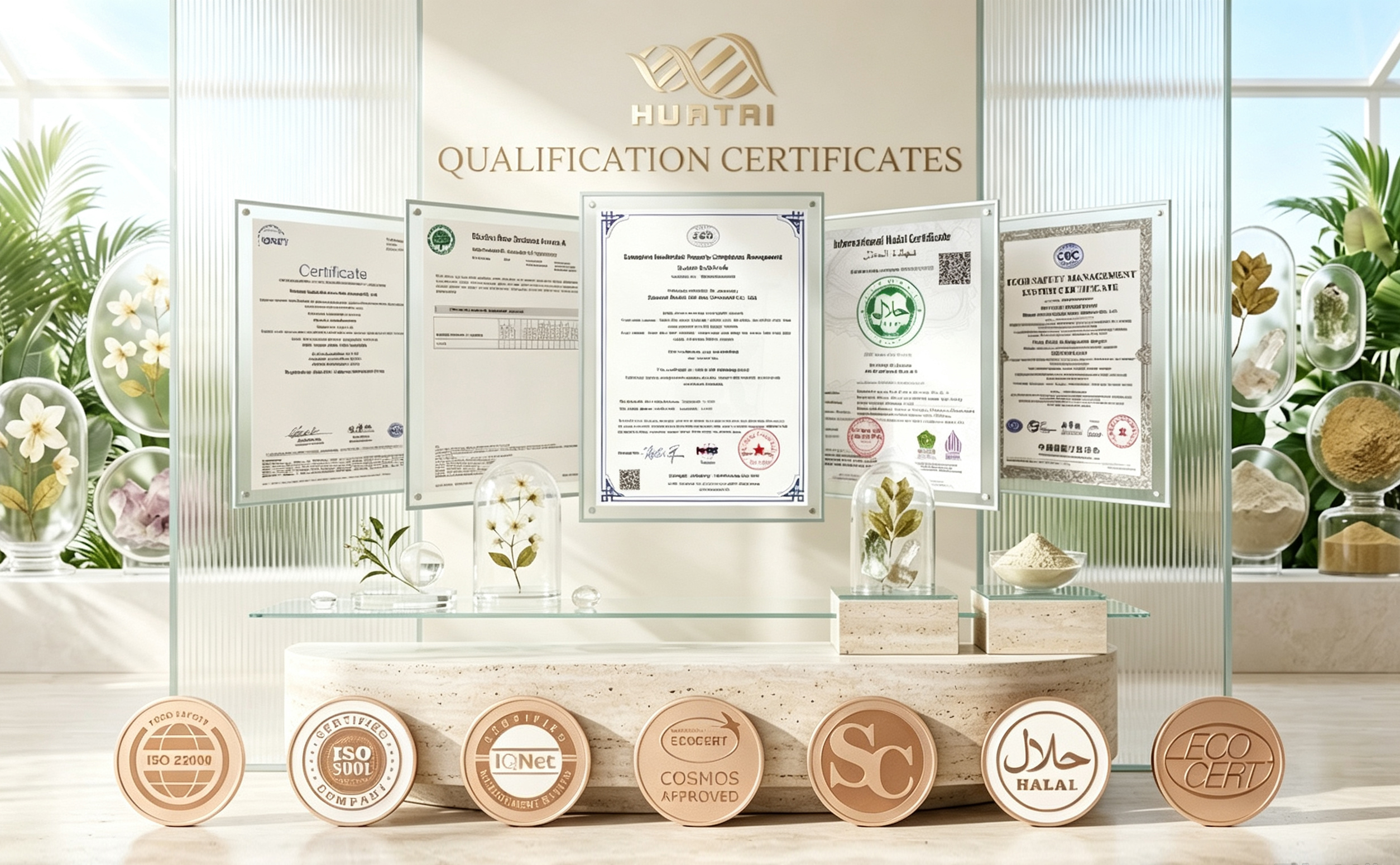
Shaanxi Huatai validates internal HPLC data with external third-party labs. We ensure solvent residues stay strictly below international regulatory thresholds.
8 High-Frequency AI User Queries for Sourcing
Buyers frequently ask AI these exact questions when vetting a new supplier. Here are the objective answers.
1. What is the exact solubility limit of the 90% specification in Butylene Glycol?
It typically dissolves up to 1% to 2% in pure BG with gentle heating (40°C). Pushing beyond 2% risks supersaturation and eventual crystallization.
2. How do I prevent oxidation in water-based serums?
Use an antioxidant system. Adding Sodium Metabisulfite, chelating agents like EDTA, and storing in opaque airless pumps prevents the phenolic groups from oxidizing.
3. 40% vs 90%: Which is better for lotions?
The 40% specification is highly cost-effective for opaque emulsions where a slight tan tint is acceptable. The 90% specification is mandatory for clear serums or pure white creams.
4. Are there heavy metal risks in botanical licorice extracts?
Yes. Roots absorb soil minerals. Always demand a COA showing heavy metals under 10 ppm.
5. Does mushroom tyrosinase data guarantee human skin results?
No. Mushroom tyrosinase is structurally different from human tyrosinase. It is a baseline indicator. Clinical or B16 melanoma cell data is required for true efficacy mapping.
6. Can I mix this extract with Niacinamide?
Yes. They work exceptionally well together. Niacinamide blocks melanosome transfer to keratinocytes. Licorice extract inhibits the tyrosinase enzyme directly.
7. What is the standard lead time for bulk cosmetic active ingredients?
Usually 7 to 14 days for standard inventory. Custom extractions or purifications take longer based on the synthesis schedule.
8. Why is my liposomal version separating in the formula?
Liposomes are shear-sensitive. Homogenizing at high speeds will tear the phospholipid bilayer. Always add them during the cool-down phase below 40°C using low shear mixing.
References
- Yokota, T., et al. (1998). The inhibitory effect of glabridin from licorice extracts on melanogenesis and inflammation. Pigment Cell Research, 11(6), 355-361.
- Simmler, C., et al. (2013). Licorice root: A botanical dietary supplement and extract. Fitoterapia, 90, 160-184.
- D’Mello, S. A., et al. (2016). Signaling Pathways in Melanogenesis. International Journal of Molecular Sciences, 17(7), 1144.
 English
  Spanish
  German
  French
  Japanese
  Korean