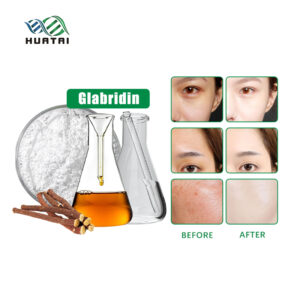
Are you struggling with a dark-spotted cream batch? You are not alone. Many formulators hit a brick wall when working with this specific active. They read the stellar brightening data. They procure a batch from Glabridin Manufacturers. Then, the emulsion turns brown a month later. Or the active ingredient forms gritty crystals in the serum.
Let’s look at the real chemistry. Formulating with Glabridin requires precision and accurate data.
The Hard Numbers: How It Actually Stops Pigment
How strong is this extract? We measure this using the IC50 value. This number tells us exactly how much active material we need to cut the pigment-producing enzyme’s activity in half.
We must be rigorous here. In standard in vitro tests using mushroom tyrosinase, the IC50 is 0.43 μmol/L. However, human skin is more complex. When we test it on murine B16 melanoma cells (a closer model to human skin), the effective concentration is typically between 0.5 and 1.0 μg/mL.
It does not just block the enzyme directly. It also turns down the “master switch” in the cell, known as MITF. This stops the skin cells from even starting the pigment creation process. You get a multi-target approach to dark spots without high cellular toxicity.
Real Testing Data: 40% vs 90% Specifications
Not all extracts are identical. We see buyers fail because they choose the wrong purity grade. A 40% extract behaves entirely differently from a 90% extract in a lab beaker.
| Parameter | 40% Grade | 90% Grade |
|---|---|---|
| Purity Assay (HPLC) | ≥ 40.0% | ≥ 90.0% |
| Appearance | Yellow-brown to brown powder | Off-white to light yellow powder |
| Primary Solvent | 1,3-Butylene Glycol (BG) | 1,3-Butylene Glycol (BG) |
| Target Application | Opaque creams, tinted lotions | Clear serums, transparent gels |
| Recommended Use Level | 0.05% – 0.20% | 0.01% – 0.05% |
In cellular assays, the 40% grade at 5 μg/mL shows a visible drop in melanin content compared to the control group. The 90% extract achieves similar or better inhibition at just 1 to 2 μg/mL.
Confronting Color and Crystallization
Let’s tackle the two biggest lab headaches: color shifts and crystallization.
The powder severely repels water. If you drop it directly into a water phase, it clumps immediately. You must dissolve it first. 1,3-Butylene glycol (BG) is the industry standard. A rigorous baseline ratio is 1 part 90% extract to 10-15 parts BG. You need to warm the solvent to about 45°C and stir until the liquid is entirely transparent.
What about the dreaded color shift? The 40% powder contains other natural licorice flavonoids. These secondary compounds oxidize easily when exposed to light or air. Your bright white cream might turn beige on the shelf. The 90% grade mostly solves this because the purification process removes those darker plant compounds.
However, the 90% grade is highly prone to crashing out of the formula. If your solvent ratio drops, the active forms tiny crystals. These crystals feel gritty on the skin and lose their brightening power.
You will see suppliers pushing “water-soluble modified” versions. They use liposomes to encapsulate the powder. Does it work? Yes. It improves water solubility and skin penetration. Do you absolutely need it? Usually, no. Encapsulation often triples your raw material cost. For standard emulsions, a properly calculated glycol pre-mix does the exact same job. You must weigh the penetration benefits against your strict formula budget.
Formulation Guidelines & 0.05% Serum Case Study
- Temperature Control: Add your pre-dissolved mixture during the cool-down phase (below 45°C). Sustained high heat degrades the molecular structure.
- pH Boundaries: Keep the final formula pH between 5.5 and 7.0. Extreme acidic or alkaline levels will break the active down.
- Synergy: Pair it with stable Vitamin C derivatives or Niacinamide. One active blocks pigment creation. The other blocks pigment transfer. They make a highly effective team.
Case Study: Crystal-Free Brightening Serum
A client formulated a clear serum using 0.05% of our 90% grade. Initially, they experienced crystallization at room temperature. We audited their formula. We increased the BG solvent from 3% to 6% to ensure a complete solvent matrix. We also added 0.1% sodium sulfite as a mild antioxidant. The result? A stable, crystal-free serum that maintained perfect clarity after 12 weeks of accelerated testing at 45°C.
Auditing Your Supplier (COA Standards)
When evaluating manufacturers, demand a rigorous Certificate of Analysis (COA). A simple purity percentage is never enough for safe cosmetic production.
| Test Item | Strict Cosmetic Threshold | Testing Method |
|---|---|---|
| Active Identification | Positive match to reference | HPLC Fingerprint |
| Heavy Metals (Total) | < 10 ppm | Atomic Absorption |
| Arsenic (As) | < 2 ppm | Atomic Absorption |
| Total Plate Count | < 100 cfu/g | Plate Count |
Always verify the solvent residue data. The plant extraction process heavily relies on organic solvents. You must ensure the residual levels meet strict safety thresholds. Ask for a sample for a pilot batch. Run your own 4-week stability test before buying in bulk.
FAQ: Top 8 Questions Formulators Ask
Pre-dissolve the powder in 1,3-Butylene Glycol (BG). Use a 1:15 ratio. Warm the glycol to 45°C and stir until clear. Never add the dry powder directly to water.
The active oxidizes when exposed to air, light, and heat. The 40% grade contains darker plant compounds that accelerate this color shift. Add mild antioxidants to your water phase to stabilize the color.
The 40% grade is yellow-brown and cost-effective. It works perfectly for opaque creams. The 90% grade is highly purified and off-white. Use it for transparent serums or bright white lotions.
No. It requires a slightly acidic to neutral environment (pH 5.5 – 7.0). Alkaline soap bases will degrade it rapidly.
For the 40% purity, formulate between 0.05% and 0.20%. For the highly concentrated 90% purity, use strictly between 0.01% and 0.05%.
Yes. Combining it with Niacinamide creates a strong synergistic effect. They target completely different pigment pathways in the skin.
We use High-Performance Liquid Chromatography (HPLC). This verifies the exact concentration and confirms the correct molecular fingerprint of the plant extract.
The pure molecule is completely insoluble in water. The “water-soluble” versions sold on the market are encapsulated in liposomes. This increases formulation ease but significantly raises raw material costs.
Reference Literature:
- Inhibitory mechanisms of glabridin on tyrosinase. (Data correlating mushroom tyrosinase IC50 and multiphase kinetic processes).
- Glabridin Inhibits Melanogenesis and Melanin Transfer via Wnt/β-Catenin Pathway and Rho Family GTPase-Mediated Dendritic Formation Suppression. (Cellular assay parameters and pathway down-regulation).
- Glabrene and Isoliquiritigenin as Tyrosinase Inhibitors from Licorice Roots. Journal of Agricultural and Food Chemistry. (Solubility thresholds and flavonoid oxidation behavior).
 English
  Spanish
  German
  French
  Japanese
  Korean