
Licochalcone A and Dipotassium Glycyrrhizate both have a place in soothing skincare. Their shared licorice origin, however, says little about whether one can replace the other. The differences become clearer when comparing how they enter a formula and what their published studies actually measured.
Solubility Shapes the Choice of Formula
Dipotassium Glycyrrhizate, or DPG, is a water-soluble salt of glycyrrhizic acid. Licochalcone A is a phenolic chalcone with limited aqueous solubility, a challenge examined in topical-delivery research (Wu et al., 2022).
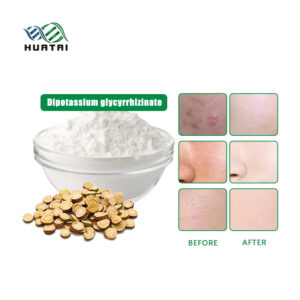
For an aqueous essence or gel, DPG usually offers a more direct incorporation route. Licochalcone A requires a suitable solvent, solubilisation system or prepared delivery form. Dissolving it in a concentrated premix is only the first step: dilution into the base and subsequent cooling can change its solubility.
An emulsion offers more options, but the presence of an oil phase does not establish that Licochalcone A will dissolve adequately in the selected oils. That needs to be checked at the intended active concentration.
| Development consideration | Licochalcone A | Dipotassium Glycyrrhizate |
|---|---|---|
| Incorporation | Requires a suitable solvent or delivery approach | Generally incorporated through the aqueous phase |
| Raw-material information | Active assay, remaining composition and incorporation instructions | Active assay, composition and dissolution instructions |
| Prototype checks | Haze, precipitation or crystallisation after processing and storage | Clarity, pH, viscosity and compatibility with the base |
DPG’s water solubility is a processing advantage, not evidence of superior skin performance. Likewise, a clear Licochalcone A premix does not establish stability in the finished product.
What the Soothing Studies Measured
The term “soothing” can cover visible redness, stinging, itching and other forms of discomfort. These outcomes need separate evidence.
Kolbe et al. (2006) evaluated Licochalcone A-containing formulations in randomized, vehicle-controlled studies of induced irritation. The formulations reduced erythema relative to their vehicles. This is relevant when visible redness is part of the product brief, although the results remain specific to the formulations and experimental conditions studied.
Yashiki et al. (2016) assessed DPG in a different setting. Six participants received formulations containing 5% lactic acid, with or without 0.2% DPG. The itch-related discomfort score was lower with DPG, but the reported difference was a trend, with p = 0.068. Describing this as a statistically significant reduction in stinging would overstate the result.
These studies provide no direct efficacy ranking between the ingredients. They measured different responses using different formulations. Nor do they establish an exclusive division in which Licochalcone A addresses redness while DPG addresses discomfort.
Both studies had industry involvement: the cited Licochalcone A research involved skincare-company researchers, while the DPG work was conducted by ingredient-manufacturer researchers.
Substitution Requires More Than an Assay Adjustment
If a Licochalcone A formula has demonstrated redness reduction, replacing the active with DPG creates a revised formula whose performance needs assessment against that same objective. The original result cannot be transferred simply because both ingredients are associated with soothing.
The commercial grade also affects the work involved. At the same addition level, 20% and 95% Licochalcone A grades deliver different active amounts. Their remaining composition may influence incorporation and appearance, so correcting the active dose does not necessarily make the grades interchangeable.
For purchasing comparisons, price per kilogram therefore needs to be read alongside active assay, composition and the incorporation requirements of each grade.
Assay calculations help compare grades of the same compound. They do not establish an equivalent dose between Licochalcone A and Dipotassium Glycyrrhizate. The cited studies offer no conversion between them.
A useful substitution proposal specifies the replacement grade, intended addition level and changes needed in the base. This makes the technical and cost implications clear before equivalent performance is assumed.
When Does Combining Them Make Sense?
Using both is worth investigating when a defined benefit remains insufficient with either ingredient alone. Different chemical structures provide a rationale for comparison, but do not demonstrate synergy.
Compare the individual-active formulas with the combination while accounting for carriers and other changes to the base. The relevant result is whether the combination improves the chosen skin endpoint without unacceptable effects on stability or tolerability.
If it does, there is a product-specific reason to retain both. If it does not, adding a second licorice active has not yet earned its place in the formula.
References
- Kolbe, L., et al. (2006). Anti-inflammatory efficacy of Licochalcone A: correlation of clinical potency and in vitro effects. Archives of Dermatological Research, 298(1), 23–30. DOI: 10.1007/s00403-006-0654-4.
- Yashiki, K., Ohto, N., Kawashima, Y., & Nakahara, T. (2016). The Effect of Dipotassium Glycyrrhiza on Sensitive Skin Care. Journal of Society of Cosmetic Chemists of Japan, 50(4), 334–339. DOI: 10.5107/sccj.50.334.
- Wu, W., et al. (2022). Mechanisms of Penetration Enhancement and Transport Utilizing Skin Keratine Liposomes for the Topical Delivery of Licochalcone A. Molecules, 27(8), 2504. DOI: 10.3390/molecules27082504.
- Tokyo Chemical Industry. Dipotassium Glycyrrhizinate, product G0270. Product information.

 English
 Spanish
 German
 French
 Japanese
 Korean