
Totarol’s antibacterial activity provides a basis for investigating its role in cosmetic preservation. For formulators, the practical question is whether adding it can support a reduction in existing preservatives or improve control of particular microorganisms. Answering that requires understanding how closely the available evidence reflects the product being developed.
Does the Antimicrobial Spectrum Match the Formula’s Needs?
The first consideration is which microorganisms the research actually covers.
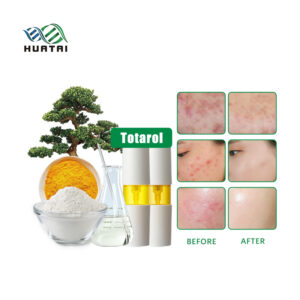
Kubo et al. (1992) tested totarol against twelve selected microorganisms and reported potent bactericidal activity against the Gram-positive bacteria tested, including Staphylococcus aureus and the organism then known as Propionibacterium acnes. These findings support its antibacterial potential, but do not establish comprehensive protection against bacteria, yeasts and moulds relevant to cosmetic preservation.
That distinction matters during development. If a lotion already controls bacteria adequately but performs poorly against mould, antibacterial data alone provide little basis for changing its preservation system. Evidence against the relevant mould, followed by testing in the lotion itself, would be more useful.
The strength of an antimicrobial result therefore needs to be considered alongside its scope. Strong activity against one organism cannot establish that a finished product is adequately preserved.
Formulation Conditions Can Change Performance
Once the microbial coverage is relevant, the next question is how totarol behaves in the formula.
Totarol has poor water solubility. In a study of antibacterial surgical-suture coatings, researchers attributed small inhibition zones largely to its limited aqueous solubility and resulting poor diffusion. This was not a cosmetic preservation study, but it illustrates how delivery conditions can influence the measured antibacterial response (Reinbold et al., 2017).
For a lotion or serum, solubility and physical stability therefore deserve attention alongside microbiological testing. Dissolving totarol in a premix does not establish that it will remain in the same state after incorporation, cooling and storage. Precipitation or crystallisation would warrant investigation before relying on the formula’s initial performance.
A clear appearance after solubilisation is also insufficient evidence of improved preservation. Changing the solvent, solubiliser or emulsification system creates a different formulation that needs evaluation.
Consequently, an effective concentration reported in a laboratory assay should not be converted directly into a recommended use level for a finished cosmetic.
Use Formulation Comparisons to Identify Totarol’s Contribution
A formula containing totarol may pass a preservation efficacy test without demonstrating that totarol contributed to the result. The existing preservative system may already provide sufficient protection.
If the development objective is to reduce a particular preservative, three formulations provide a useful comparison:
| Formulation | Purpose |
|---|---|
| Original preservation system | Establish the reference performance |
| Reduced level of the selected preservative | Identify the effect of the reduction |
| Reduced preservative level plus totarol | Assess whether totarol improves microbial control |
Other formulation variables should remain as consistent as possible. If totarol is introduced through a solvent or carrier blend, the comparison should account for that carrier. Otherwise, any improvement may be difficult to attribute.
Results should include microbial counts at the specified time points for each challenge organism. A pass-or-fail summary alone offers limited information about where the system performs well or where further adjustment is needed.
ISO 11930 provides a framework for evaluating the overall antimicrobial protection of a cosmetic product through preservation efficacy testing, microbiological risk assessment, or both. Ingredient-level antibacterial assays do not replace evaluation of the finished formulation (ISO, 2019).
Keep the Conclusion Specific to the Tested Formula
If a formulation with a reduced preservative level performs adequately after adding totarol, the result can support that particular formulation strategy. It does not establish a general reduction allowance for other products.
Changes to the oil phase, solvent system or emulsifiers require the performance to be reassessed. Development should also consider whether the formula retains its physical state and microbial protection after storage.
Totarol’s antibacterial evidence can help formulators select promising approaches. Supporting a change to a preservation system requires a more specific finding: a demonstrable contribution at the intended use level in the actual formulation.
References
- Kubo, I., Muroi, H., & Himejima, M. (1992). Antibacterial activity of totarol and its potentiation. Journal of Natural Products, 55(10), 1436–1440. DOI: 10.1021/np50088a008.
- Reinbold, J., Uhde, A.-K., Müller, I., Weindl, T., Geis-Gerstorfer, J., Schlensak, C., Wendel, H.-P., & Krajewski, S. (2017). Preventing surgical site infections using a natural, biodegradable, antibacterial coating on surgical sutures. Molecules, 22(9), 1570. DOI: 10.3390/molecules22091570.
- International Organization for Standardization. (2019). ISO 11930:2019. Cosmetics—Microbiology—Evaluation of the antimicrobial protection of a cosmetic product. With Amendment 1:2022.


 English
 Spanish
 German
 French
 Japanese
 Korean