
Glabridin is a flavonoid naturally found in licorice root (Glycyrrhiza glabra). As an isoflavan-type flavonoid, it is one of the characteristic active compounds identified from this botanical source.
In cosmetic development, Glabridin is mainly discussed as a botanical active for pigmentation-related applications, with additional interest in antioxidant support and skin-conditioning roles.
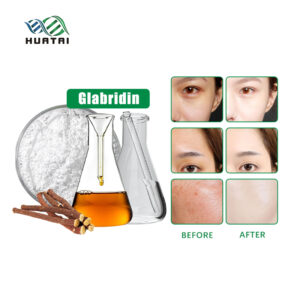
Unlike a complete plant extract, Glabridin is evaluated as a defined active compound with controlled specifications.
For formulation teams, the ingredient name is only the beginning of the evaluation process.
Early discussions usually focus on several practical aspects: the botanical source, the difference between Glabridin and licorice extract, and how the ingredient behaves in a finished cosmetic formula.
In practice, ingredient selection often depends on technical details such as specification, compatibility, and formulation behavior.
From Licorice Root to a Defined Cosmetic Active
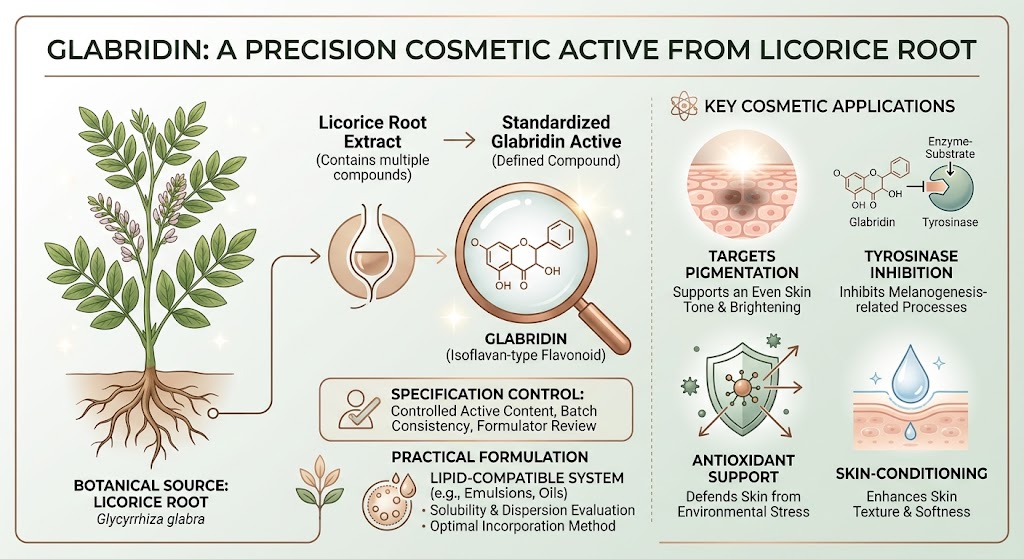
Licorice root contains multiple naturally occurring compounds. The composition of a licorice extract may change depending on the raw material source and extraction process.
Among these compounds, Glabridin is one defined active component used in cosmetic development.
Unlike a complete botanical extract, a standardized Glabridin cosmetic ingredient is evaluated around a specific active specification. During raw material review, formulators usually look at active content, batch consistency, and compatibility with the intended formula.
Licorice extract is often selected for products that emphasize the broader botanical profile. Standardized Glabridin is more focused on a defined active marker and specification control.
Glabridin in Skincare: Where Is It Used?
In skincare formulations, Glabridin is mainly associated with pigmentation-focused products. Antioxidant support and skin-conditioning applications are also considered during ingredient evaluation.
Pigmentation-related applications have received considerable research attention.
Studies have investigated the relationship between Glabridin and melanogenesis-related processes, including tyrosinase activity. Since tyrosinase participates in melanin formation, it is often included in laboratory evaluation of brightening-related cosmetic ingredients.
However, laboratory results need to be viewed within the right context.
An enzyme assay can provide information about a possible activity pathway, but it does not reproduce the complete environment of a finished cosmetic product.
Once an active ingredient enters a formula, additional factors become involved:
- concentration used in the product
- interaction with other ingredients
- formula structure
- processing conditions
- storage stability
In practical development work, this is often where the main evaluation begins. A promising laboratory result still needs to perform within the intended formulation system.
From Research Data to Practical Formulation
A common situation in cosmetic development is that an ingredient performs well during early testing, but additional questions appear once it enters the formula.
The first challenge is often straightforward:
Can the ingredient be incorporated properly?
Glabridin has limited water solubility and is generally considered more suitable for lipid-compatible systems. This characteristic can influence how it is introduced into different product formats.
A water-based serum, an emulsion, and an oil-containing product may require different approaches.
Depending on the formulation system, developers may need to evaluate:
- dispersion method
- solvent selection
- delivery approach
- compatibility with supporting ingredients
There is no single solution that applies to every formula. The suitable approach depends on the final product design.
Stability and Quality Considerations
Stability is an important part of developing products with botanical-derived actives.
The behavior of an ingredient may change after entering a complex formulation.
Factors such as:
- processing temperature
- light and oxygen exposure
- packaging conditions
- interaction with other ingredients
can influence long-term performance.
A raw material that meets specification requirements still needs to be evaluated in the final formula.
The consistency of the raw material itself also matters.
For Glabridin, factors such as licorice source, extraction technology, purification process, and analytical methods may influence ingredient quality.
Clear specifications and reliable technical documentation support better evaluation during product development.
Evaluating Glabridin as a Cosmetic Ingredient
Glabridin combines botanical origin with a defined active compound, which is one reason it continues to receive attention in cosmetic development.
During ingredient evaluation, published studies are usually the starting point. Later discussions often move toward specification review, formulation compatibility, and performance testing in the target product system.
For cosmetic R&D teams, these factors are considered together.
A good ingredient evaluation is not only about activity data. It also involves understanding how the ingredient behaves in a real formulation.
Frequently Asked Questions
1. What is Glabridin used for in skincare formulations?
Glabridin is mainly evaluated in pigmentation-focused skincare products, while antioxidant support and skin-conditioning applications are also areas of interest.
2. Is Glabridin the same as licorice extract?
No. Licorice extract contains multiple compounds from licorice root, while Glabridin is a specific isoflavan-type flavonoid obtained from licorice and supplied with controlled specifications.
3. Why do cosmetic formulators choose Glabridin as an ingredient?
A standardized Glabridin cosmetic ingredient provides a defined active specification, which helps manufacturers evaluate batch consistency, formulation compatibility, and product development requirements.
4. How is Glabridin different from other botanical active ingredients?
Glabridin comes from a botanical source but represents a defined active compound rather than a complete plant extract. This allows developers to evaluate the ingredient through controlled specifications and technical data.
5. What should formulators consider when using Glabridin?
Solubility, incorporation method, formula compatibility, stability, and the final product format are common considerations during development.
References
- Yokota T., et al. “The inhibitory effect of glabridin from licorice extracts on melanogenesis.” Pigment Cell Research, 1998.
- Nerya O., et al. “Inhibition of cyclooxygenase and tyrosinase by glabridin.” Phytochemistry, 2003.

 English
  Spanish
  German
  French
  Japanese
  Korean