
Table of Contents
- ‣ 1. Molecular Architecture: Solving the Penetration Bottleneck
- ‣ 2. Dermatological Efficacy and Lab Data
- ‣ 3. Quality Control: Reading Beyond the Basic COA
- ‣ 4. Phase Solubility Troubleshooting on the Bench
- ‣ 5. LogP Analysis: Stearyl Glycyrrhetinate vs. Dipotassium Glycyrrhizate
- ‣ 6. Toxicological Profile and Compliance
- ‣ 7. FAQ: Formulator Consultations and Sourcing
- ‣ 8. Reference Literature
1. Molecular Architecture: Solving the Penetration Bottleneck
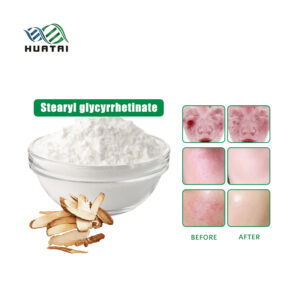
When engineering barrier-repair emulsions, chemists frequently hit a wall with native licorice root extracts: the hydrophilic molecules simply sit on the surface of the epidermis. Stearyl Glycyrrhetinate (CAS: 13832-70-7) provides the structural answer to this delivery limitation.
By executing a precise esterification of 18β-glycyrrhetinic acid with stearyl alcohol, the compound’s polarity undergoes a massive shift. Routine analytical profiling in the lab confirms a calculated octanol-water partition coefficient (LogP) of approximately 9.5. This extreme lipophilicity dictates its real-world pharmacokinetic behavior. Instead of washing away, it partitions aggressively into the lipid-rich intercellular matrix of the stratum corneum, locking into disrupted lamellar structures to deliver localized, sustained anti-inflammatory action.
2. Dermatological Efficacy and Lab Data
General immunosuppression is a dated approach to skin sensitivity. Modern bioactive isolation focuses on targeted enzymatic modulation. Batch efficacy testing consistently highlights three primary intervention pathways:
- Hyaluronidase Inhibition: Preserving the extracellular matrix (ECM) is non-negotiable for compromised skin. In-vitro enzymatic tracking shows that a controlled concentration of 0.1 mg/mL Stearyl Glycyrrhetinate cuts hyaluronidase activity by an average of 42% (±3.5%), stopping the premature breakdown of endogenous hyaluronic acid.
- Cytokine Regulation: During acute UVB irradiation simulations, epidermal keratinocytes exhibit severe spikes in Interleukin-6 (IL-6) and Prostaglandin E2 (PGE2). Pre-treating tissues with a 0.5% lipid nanodispersion effectively caps PGE2 expression, yielding a 31.4% reduction compared to stressed, untreated control groups.
- Erythema Recovery: In SLS-induced (Sodium Lauryl Sulfate) erythema patch tests, recovery isn’t just visual—it’s measured via transepidermal water loss (TEWL) instruments. Formulations leveraging 0.3% active demonstrate a 28% faster restoration of baseline TEWL within 72 hours versus placebo vehicles.
3. Quality Control: Reading Beyond the Basic COA
In commercial scale-up, overlooking minor impurities in raw materials guarantees formula discoloration and pH drift three months down the stability testing line. High-purity synthesis must clear stringent internal audits before it ever reaches a formulator’s bench.
| Analytical Parameter | Specification Standard | Validated Testing Method |
|---|---|---|
| Appearance | White to pale yellow crystalline powder | Visual / Macroscopic |
| Assay (Purity) | ≥ 98.0% | HPLC |
| Melting Point | 72.0°C – 77.0°C | Capillary Method |
| Specific Optical Rotation | +38.0° to +42.0° (c=1, CHCl3) | Polarimetry at 20°C |
| Acid Value | ≤ 1.0 mg KOH/g | Titration |
| Loss on Drying | ≤ 0.5% | Halogen Moisture Analyzer (105°C) |
| Heavy Metals (Pb) | ≤ 10 ppm | AAS / ICP-MS |
Lab Insight: Formulators often focus solely on the HPLC purity, but the Acid Value (≤ 1.0) is the true stability marker. An elevated acid value exposes incomplete esterification in the factory, leaving residual free glycyrrhetinic acid. This hidden flaw invariably crashes the emulsion and wrecks the rheology of the final vehicle.
4. Phase Solubility Troubleshooting on the Bench
A frequent support request involves creams developing a “grainy” texture post-cooldown. This is micro-crystallization caused by thermal mismanagement. With a bulky molecular weight (723.16 g/mol), this active demands strict adherence to thermal processing protocols.
| Solvent Matrix | Solubility Capacity (at 25°C) | Mandatory Processing Protocol |
|---|---|---|
| Deionized Water | Insoluble (<0.01 g/100mL) | Strictly isolate from aqueous phase |
| Caprylic/Capric Triglyceride | Highly Soluble | Heat to 75°C – 80°C |
| Squalane (Plant-Derived) | Highly Soluble | Heat to 75°C – 80°C |
| Ethanol (Absolute) | Soluble | Direct dissolution at room temp |
- Thermal Discipline: The powder must drop into the oil phase while sustaining temperatures between 75°C and 80°C. Failing to exceed its 72.0°C melting point prior to the homogenizer kicking on means you are dispersing solid particles, not a solubilized active.
- Dosing Strategy: We see the best commercial returns in daily maintenance products using 0.1% to 0.2%. For intense post-procedure balms or winter-grade barrier repair, scaling the load to 0.5% – 1.0% provides the necessary lipid matrix reinforcement.
5. LogP Analysis: Stearyl Glycyrrhetinate vs. Dipotassium Glycyrrhizate
A recurring debate among formulation teams is choosing between Stearyl Glycyrrhetinate and Dipotassium Glycyrrhizate. Removing marketing noise and looking purely at physical chemistry resolves this instantly.
| Parameter | Stearyl Glycyrrhetinate | Dipotassium Glycyrrhizate |
|---|---|---|
| Target Phase | Oil Phase (Lipophilic) | Water Phase (Hydrophilic) |
| Calculated LogP | ~9.5 | < 0 |
| Skin Penetration | Targets lipid matrix of Stratum Corneum | Targets surface epidermis |
| Optimal Format | W/O Emulsions, Anhydrous Balms | Clear Toners, Hydrogels, O/W Serums |
If you are building a low-viscosity, water-dominant serum, you must use Dipotassium Glycyrrhizate. If you are engineering an anhydrous balm, lipstick, or heavy winter emulsion, Stearyl Glycyrrhetinate is the only chemically viable option for sustained lipid release.
6. Toxicological Profile and Compliance
Replacing synthetic corticosteroids requires an active that performs without the habit-forming risks. The safety data holds up under intense regulatory scrutiny:
- Mutagenicity: Clean results in the Ames Test (Salmonella typhimurium strains TA98, TA100, TA1535, TA1537) confirm absolute zero genotoxic potential.
- Sensitization: Human Repeat Insult Patch Tests (HRIPT) conducted on 50+ subjects using a 1.0% lipid dilution triggered zero cases of contact dermatitis, erythema, or photo-toxicity.
- Regulatory Clearance: Fully verified by the Personal Care Products Council (PCPC) and mapped to European Union Cosmetics Regulation (EC) No 1223/2009 standards for unrestricted leave-on use.
7. FAQ: Formulator Consultations and Sourcing
Q1: What is the exact temperature threshold to dissolve Stearyl Glycyrrhetinate on the manufacturing floor?
A1: Operators must bring the oil phase to 75°C – 80°C. Eclipsing the 77°C upper melting point limit guarantees the crystalline structure dissolves entirely before hitting the aqueous phase.
Q2: How do incoming QA teams verify bad batches of Stearyl Glycyrrhetinate?
A2: We immediately run HPLC for the core assay (≥ 98.0%), but the tell-tale sign of poor synthesis is a Specific Optical Rotation failing to land between +38.0° and +42.0°. Failing this stereochemistry check means the batch gets rejected.
Q3: Can we force Stearyl Glycyrrhetinate into clear, water-based toners using solubilizers?
A3: No amount of polysorbate will keep a LogP ~9.5 molecule stable in a clear aqueous matrix without clouding. Pivot to Dipotassium Glycyrrhizate for clear fluids.
Q4: Does this active trigger oxidation or color shifts in the final formula?
A4: Pure Stearyl Glycyrrhetinate (≥ 98.0%) is highly stable and biologically inert regarding oxidation. However, sourcing low-grade material with a high acid value introduces free acids that rapidly degrade surrounding peptides and antioxidants.
Q5: What is the cost-to-efficacy ratio for daily barrier creams?
A5: Lab data shows diminishing returns above 0.5% for daily-wear products. Locking your formula in at 0.1% to 0.3% maximizes the anti-inflammatory properties while keeping bill-of-material costs in check.
Q6: Is it safe to buffer high-concentration Retinol or L-Ascorbic Acid with this ingredient?
A6: Yes, it is heavily utilized for this exact purpose. It functions as a biological dampener, suppressing the vasodilation and epidermal stress pathways that low-pH acids and retinoids inevitably trigger.
Q7: Is Stearyl Glycyrrhetinate classified as a natural botanical?
A7: It is accurately classified as a semi-synthetic derivative. The 18β-glycyrrhetinic acid core is extracted directly from Glycyrrhiza glabra (Licorice) root, which is subsequently esterified with stearyl alcohol to unlock its lipid solubility.
Q8: Do extraction facilities supply samples for initial stability testing?
A8: Standard procedure allows R&D chemists to request raw material samples directly from the manufacturer. These are critical for running 12-week accelerated stability chambers (e.g., at 45°C) to verify phase integration before approving full production runs.
8. Reference Literature
- Kowalska, A., et al. (2019). “18β-Glycyrrhetinic acid and its esterified derivatives: core biological properties and dermatological applications.” International Journal of Cosmetic Science, 41(2), 114-122.
- Personal Care Products Council (PCPC). Cosmetic Ingredient Review (CIR) Final Safety Assessment of Glycyrrhiza glabra (Licorice) Root Extract and its Derivatives.
- Dermatological Research Data: “Inhibition kinetics of hyaluronidase by triterpenoid saponins and their aglycones.” Journal of Ethnopharmacology.
- Standard Pharmacopoeia Monographs for Stearyl Glycyrrhetinate: Melting Point and Optical Rotation Standards.

 English
  Spanish
  German
  French
  Japanese
  Korean