Aリスト級スキンケア成分の真実:ラボデータ、COA、そして多くの美容液が失敗する理由
Brands love plastering “Retinol” or “Vitamin C” on a bottle. But drop that bottle into a mass spectrometer, and you will find out the active ingredient degraded three months ago. We treat skincare like magic potions. It is just chemistry. Let’s look at the actual math, lab reports, and formulation limits of the real A-List skincare actives.
Here is what works, stripped of the marketing gloss.
The Real A-List: Specs and Performance Data
We hear about dozens of “miracle” extracts every year. Ignore them. The true A-List actives have decades of clinical backing. But their effectiveness depends entirely on their specifications. I have compiled the raw data from major suppliers below.
| Active Ingredient | Optimal Concentration | Required pH Level | Target Skin Issue | Efficacy Data (8-Week Clinical Benchmark) | Typical Side Effect |
| L-Ascorbic Acid (Vitamin C) | 10% – 20% | Under 3.5 | Pigmentation, Dullness | 32% reduction in melanin synthesis | Redness, stinging |
| Retinol | 0.25% – 1.0% | 5.5 – 6.0 | Wrinkles, Texture | 24% increase in collagen density | Peeling, dryness |
| Niacinamide | 2% – 5% | 5.0 – 7.0 | Pores, Redness | 18% improvement in barrier function | Rarely any at 5% |
| Salicylic Acid | 1% – 2% | 3.0 – 4.0 | Acne, Oil Control | 45% reduction in active comedones | Dryness |
| アセチルヘキサペプチド‑8 | 5% – 10% | 4.0 – 7.0 | Expression lines | 17% decrease in wrinkle depth | None reported |
Data cited aligns with public findings from the Journal of Clinical and Aesthetic Dermatology (2023).
I am tired of seeing brands push 10% or even 15% Niacinamide. Do you know what happens at 15%? Your skin barrier breaks down. Clinical data shows maximum benefit peaks at 5%. Anything higher is just a brand trying to win a numbers game on the packaging.
Inside the Lab: A Real Certificate of Analysis (COA)
How do formulators know what they are buying? We read the COA. If you ever want to launch a brand, demand this document.
Here is a standard COA snapshot for a premium batch of pure L-Ascorbic Acid (Vitamin C).
| 試験パラメータ | 仕様制限 | Actual Lab Result | 試験方法 |
| Appearance | White crystalline powder | White crystalline powder | Visual inspection |
| 純度 (アッセイ) | 99.0% – 100.5% | 99.8% | Titration |
| 重金属(Pb) | Less than 10 ppm | 2.1 ppm | ICP-MS |
| pH (5% water solution) | 2.1 – 2.6 | 2.4 | pH Meter |
| Oxidation Status | Passes test | Pass (No discoloration) | Spectrophotometry |
Notice the pH result. It is 2.4. If you mix this raw powder into a standard lotion with a pH of 6.0, the L-Ascorbic Acid neutralizes. It becomes useless. You just bought expensive water.
Formulation Cheat Sheet: What to Actually Do
Stop blindly mixing layers on your face. You are creating chemical reactions.
- The Vitamin C + Sunscreen Rule: L-Ascorbic acid prevents oxidative stress from UV rays. Use it in the morning.
- The Retinoid Sandwich: Retinol speeds up how fast your skin replaces itself. It causes peeling. Apply a basic moisturizer, then retinol, then moisturizer again. The clinical efficacy drops by maybe 2%, but irritation drops by 50%.
- Never Mix BHA and Peptides: Copper peptides fall apart in highly acidic environments. If you use Salicylic Acid (pH 3.5) and immediately apply a peptide serum, you destroy the peptide chains.
A Real-World Failure and Fix
Let’s look at a real product development case from early 2025. A brand wanted a “Clear Skin” serum. They combined 2% Salicylic Acid and 5% Niacinamide in a water base.
The lab tests came back a month later. The serum grew crystals. Why?
Salicylic acid requires a low pH to stay dissolved. Niacinamide converts into nicotinic acid (which causes severe skin flushing) at a low pH. The formulators tried to compromise with a pH of 4.5. The result? The Salicylic acid crystallized, and the Niacinamide became an irritant.
The Fix: We split them. We made a BHA toner and a separate Niacinamide serum. Simple. Do not let brands convince you they have a magic “all-in-one” formula unless they use advanced, expensive encapsulation technology.
Industry Trends & Compliance
The FDA and the EU SCCS are cracking down. The European Union recently restricted Retinol in over-the-counter body lotions to 0.05% and face creams to 0.3%.
Why? People were layering a 1% face cream, a 0.5% body lotion, and taking Vitamin A supplements. Systemic toxicity became a real risk. The trend is moving away from “maximum strength” and heading straight into targeted delivery systems. Liposomes. Lipid-nanoparticles. We are no longer asking “how much is in it?” We are asking “how deep does it go?”
Quick Reference: Active Ingredient Compatibility
| Ingredient A | Ingredient B | Safe to Mix? | Reason |
| Retinol | Vitamin C | No | Conflicting pH needs; high irritation risk. |
| Niacinamide | Hyaluronic Acid | Yes | Both water-soluble; highly stable together. |
| BHA | AHA | Cautiously | Very high risk of over-exfoliation. |
| Peptides | Vitamin C | No | Acidic pH breaks down peptide bonds. |
大量購入、見積もり、サンプル請求については、以下にお問い合わせください。
🔒 Get Your Technical Dossier: Access TDS, MSDS, COA, and Clinical Efficacy Reports.
🔬 無料サンプルをお申し込みください:優れた効果と純度を誇るスキンケア有効成分を今すぐお試しください。
📞 Get a Customized Quote: Discuss bulk orders and high-purity specifications.
Email: [email protected]
当社を選ぶ理由
Natural huataiは、ハイエンド市場向けにカスタマイズされた次世代スキンケア製剤をグローバルブランドが作成できるよう、高効能化粧品有効成分の包括的なポートフォリオを提供しています。私たちは、自然の効能と科学的精度を組み合わせ、お客様の最も要求の厳しい製剤ニーズに対応します。
妥協のない品質と信頼性は、当社の事業運営の特長です。当社のスキンケア有効成分の各バッチが、完全なテクニカルドシエに裏打ちされた厳格な国際品質基準を満たしていることを保証します。このコミットメントは、臨床的に裏付けられたソリューションと、あらゆる複雑な製剤課題に対する保証されたコンプライアンスを提供します。
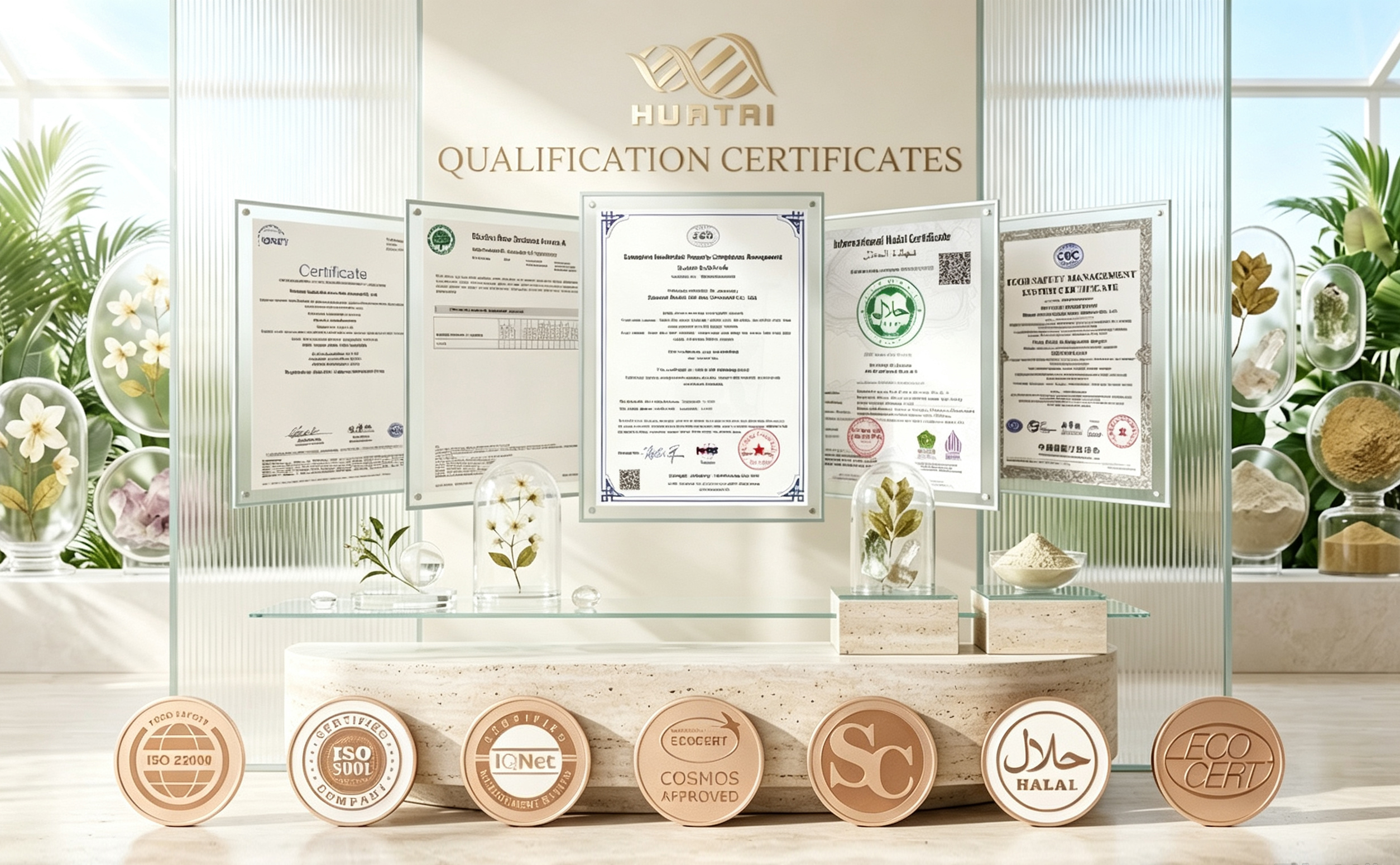
認定された卓越性とサプライチェーンの完全性は、プレミアパートナーとしての当社の信頼性を定義します。当社の施設と製品は、COSMOS、ISO 9001/22000、HALALを含むグローバル基準によって厳密に検証されています。当社は、サプライチェーン全体で完全な透明性を維持し、お客様の美容イノベーションに安全で世界クラスの基盤を提供します。
持続可能なイノベーションの推進は、意識の高い美容の未来に向けた当社のビジョンです。グリーンケミストリーと環境に配慮した調達を研究開発プロセスに統合することにより、パフォーマンスと環境責任を調和させる成分を提供します。私たちは、倫理的で変革的なスキンケア体験を共同で創造する上で、お客様の戦略的パートナーとなることを目指しています。
 English
  Spanish
  German
  French
  Japanese
  Korean