
Glabridin in skincare is mainly studied for pigmentation-related applications. When looking at Glabridin uses, however, biological activity is only one part of ingredient evaluation. For those researching Glabridin for skin, formulation behavior and stability are also important when moving from ingredient research to product development.
For cosmetic R&D, the more useful questions are straightforward:
• What does the current evidence actually show?
• How does Glabridin behave in a formulation?
• And what should be considered when selecting the raw material?
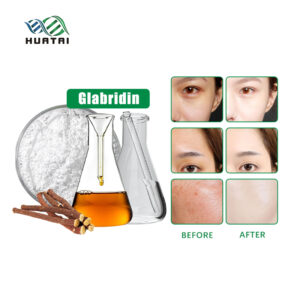
Where Glabridin Fits in Skincare
Glabridin is a licorice-derived prenylated isoflavan that has been studied particularly for its effects on melanogenesis.
One of the main research areas is tyrosinase-related pigmentation. In a 1998 study, Yokota et al. reported that Glabridin inhibited tyrosinase activity in cultured B16 murine melanoma cells. Topical application of 0.5% Glabridin also reduced UVB-induced pigmentation and erythema in guinea pig skin. (Yokota et al., 1998 — PubMed)
These results provide a scientific basis for considering Glabridin in pigmentation-related formulations. However, the model and experimental conditions still matter. Cell and animal studies can support an ingredient’s biological rationale, but they should not be treated as direct evidence of the performance of every Glabridin-containing cosmetic.
What the Tyrosinase Research Tells Us
Tyrosinase is an important enzyme in melanin biosynthesis and is therefore frequently used to study pigmentation-related ingredients.
Research on Glabridin has used different analytical approaches. A 2022 study using conventional spectrophotometry and real-time oxygen sensing reported mixed-type inhibition of mushroom tyrosinase and noted differences from some previous reports on the inhibition mechanism. (Guo et al., 2022 — PubMed)
This is a useful reminder when interpreting enzyme data. The observed inhibition pattern can depend on the experimental system, substrate, and analytical method. A specific inhibition model or IC50 value should therefore be understood as an assay-specific result, rather than a fixed performance parameter for Glabridin in a cosmetic formula.
For formulation teams, the more relevant question is what happens after the ingredient leaves the test system and enters the actual product.
What Changes in a Formulation?
Glabridin has limited water solubility, so its raw material form and the formulation environment can affect incorporation and distribution. This makes several practical factors relevant:
| Formulation Factor | Impact / Consideration |
|---|---|
| Raw Material Grade | Physical form dictates how it needs to be processed. |
| Solubility | Must match the selected formulation system due to limited water solubility. |
| Processing | Incorporation process and temperature can alter active integrity. |
| Distribution | Risk of precipitation or uneven distribution if not formulated correctly. |
| Storage Stability | Stability behavior during long-term storage varies by formula. |
The same nominal concentration may therefore behave differently in different formulations. This is why selecting Glabridin based only on assay value is not enough. The form in which the active is supplied also needs to match the intended product system.
Stability Is Part of the Formulation Decision
Glabridin stability is condition-dependent. Ao et al. investigated the effects of temperature, illumination, humidity, pH, solvent, oxygen and oxidants on Glabridin stability. Their results showed that several factors could affect stability, with illumination having a particularly important effect. The study also reported interactions between temperature, pH, humidity and illumination that could promote degradation. (Ao et al., 2010 — PubMed)
The study used licorice extract containing approximately 20% Glabridin, rather than a purified cosmetic Glabridin grade, so the findings should be interpreted within that experimental context.
For formulation development, the practical implication is to evaluate stability under the actual product conditions rather than applying a single stability value across different formulations. pH, processing temperature, light exposure, packaging, and interactions with other ingredients may all need to be considered.
Selecting Glabridin as a Cosmetic Raw Material
For B2B ingredient development, Glabridin should be evaluated as a formulation material rather than simply as a chemical name or assay number. A practical assessment should include:
| Assessment Parameter | Key Question |
|---|---|
| Active content & specification | Is the declared Glabridin content supported by an appropriate analytical method? |
| Physical form & solubility | Is the supplied form suitable for the intended formulation? |
| Processing requirements | Can it be incorporated under practical processing conditions? |
| Stability information | Is there sufficient information to support handling and formulation development? |
| Quality documentation | Are COA, specifications, and analytical methods available for technical evaluation? |
A high assay value can be important, but it does not automatically mean better formulation performance. The more useful question is whether the selected grade provides the required active content and works reliably in the intended product system.
A Practical Way to Read Glabridin Evidence
Glabridin research illustrates an important point in cosmetic ingredient evaluation: biological activity and formulation performance are related, but they are not the same thing.
- Enzyme and cell studies can explain why an ingredient is scientifically interesting.
- Animal studies can provide additional topical evidence.
- Formulation and stability studies address whether the ingredient can actually function within a product system.
These forms of evidence should not be used interchangeably.
For R&D teams, the question is not simply:
“Does Glabridin work?”
A more useful question is:
“Does this Glabridin grade provide the intended function under the conditions of the target formulation?”
That shift keeps ingredient selection connected to actual product development.
Frequently Asked Questions (FAQ)
| What does glabridin do to the skin? | Glabridin is mainly used in cosmetic formulations where pigmentation-related skin concerns are part of the product development objective. Its potential activity is related to its effects on melanogenesis, while its actual performance depends on the formulation and the specific raw material used. |
| What are the side effects of glabridin? | There is no single established side-effect profile that can be applied to every Glabridin-containing cosmetic. Tolerability can depend on concentration, formulation, exposure conditions and individual skin response. For product development, finished-formula safety and compatibility should be evaluated. |
| What does licorice do for your face? | Licorice has a long history of use in cosmetic formulations, and licorice-derived ingredients are commonly considered when developing products for skin conditioning and pigmentation-related concerns. The specific properties depend on which compounds are present in the selected licorice material. |
| What does licorice root extract do for your skin? | Licorice root extract is a botanical mixture rather than a single defined active. Its composition can vary according to the plant material, extraction process, and standardization. The properties of one extract should not automatically predict another, and research on purified Glabridin shouldn’t be directly applied to every licorice root extract. |
References
- Yokota T, Nishio H, Kubota Y, Mizoguchi M. The inhibitory effect of glabridin from licorice extracts on melanogenesis and inflammation. Pigment Cell Research. 1998;11(6):355–361.
- Guo Y, Cariola A, Matera R, Gabbanini S, Valgimigli L. Real-time oxygen sensing as a powerful tool to investigate tyrosinase kinetics allows revising mechanism and activity of inhibition by glabridin. Food Chemistry. 2022;393:133423.
- Ao M, Shi Y, Cui Y, Guo W, Wang J, Yu L. Factors influencing glabridin stability. Natural Product Communications. 2010;5(12):1907–1912.

 English
  Spanish
  German
  French
  Japanese
  Korean