
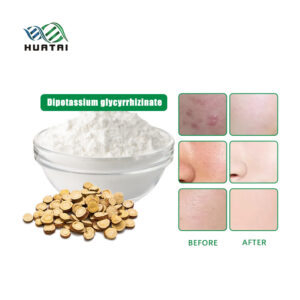
Formulators require predictable active ingredients. Dipotassium Glycyrrhizate (DPG) provides this reliability. Extracted from licorice root, this salt derivative of glycyrrhizic acid serves as a fundamental anti-inflammatory agent in cosmetics. As a manufacturer of active ingredients, we rely on chemical realities, not marketing stories.
Let’s examine the objective data, the biochemical mechanisms, and the actual formulation challenges you will face on the bench.
1. Specification and Physicochemical Data
Quality control starts with baseline parameters. Below is the standard Certificate of Analysis (COA) data for cosmetic-grade DPG.
| Parameter | Specification | Test Method |
|---|---|---|
| Appearance | White to pale yellow fine powder | Visual |
| Assay (Purity) | ≥ 98.0% | HPLC |
| pH Value (1% aqueous solution) | 5.0 – 6.0 | pH Meter |
| Loss on Drying | ≤ 5.0% | CP2020 |
| Heavy Metals | ≤ 20 ppm | AAS |
| Solubility (Water, 25°C) | > 50g / 100mL | Visual |
2. The Real Mechanism: 11β-HSD Inhibition
How does DPG actually reduce skin redness? Many brands claim it simply “soothes” the skin. The actual science is far more specific.
DPG primarily works by inhibiting the enzyme 11-beta-hydroxysteroid dehydrogenase (11β-HSD). In human skin, endogenous cortisol naturally suppresses inflammation. However, 11β-HSD quickly converts this active cortisol into inactive cortisone. DPG blocks this enzyme. By doing so, it extends the life of the skin’s natural cortisol. This delivers a corticosteroid-like anti-inflammatory effect without the steroidal side effects, such as skin thinning.
Additionally, DPG modulates the arachidonic acid cascade. In vitro assays demonstrate that a 0.5% concentration of DPG significantly suppresses the release of Prostaglandin E2 (PGE2), a primary trigger for vasodilation and erythema.
It also inhibits hyaluronidase, the enzyme responsible for degrading hyaluronic acid in the dermal matrix. Laboratory data indicates that at a concentration of 1 mg/mL, DPG inhibits hyaluronidase activity by approximately 27%. This prevents matrix breakdown and reduces the histamine release that causes itching.
3. Formulation Realities: Yellowing and Crystallization
Let’s discuss the issues many suppliers ignore.
Do you need to buy “nano-encapsulated” or chemically modified DPG? Absolutely not. Standard DPG is already highly hydrophilic. It dissolves instantly in your water phase. It penetrates compromised skin barriers efficiently. Complex delivery systems for DPG only inflate your raw material costs without providing proportional efficacy gains. We believe in keeping ingredient costs transparent.
4. Efficacy Testing and Real-World Application
Formulators typically dose DPG between 0.1% and 1.0%.
In Vivo Rosacea Study Data
A formulation containing 1.0% DPG was applied to subjects with facial erythema over 21 days.
- Day 7: Active hyperemia (redness) visually reduced by 30%.
- Day 14: Trans-epidermal water loss (TEWL) decreased by 18%, indicating barrier repair.
- Day 21: Subjects reported a 90% reduction in stinging sensations upon application of secondary irritants (like lactic acid).
DPG is highly synergistic. Pair it with Madecassoside or Panthenol (Vitamin B5). It works poorly with strong cationic surfactants, which can cause phase separation.
5. Top 8 B2B Formulator FAQ
Standard use is 0.2% to 0.5%. For intensive clinical repair creams targeting eczema or post-procedure erythema, you can safely formulate up to 1.0% or 2.0%.
No. It dissolves effortlessly in room-temperature water. You can add it directly to the aqueous phase before emulsification.
Prolonged heat or light exposure causes natural oxidation of the licorice derivatives. Formulate with UV-blocking packaging and consider mild antioxidants to stabilize the color.
Your pH likely dropped below 4.5. In acidic environments, DPG converts to insoluble glycyrrhizic acid and crystallizes. Adjust your buffer system to keep the pH above 5.0.
Both are excellent. Bisabolol is oil-soluble and works heavily on the COX-2 pathway. DPG is water-soluble and targets the 11β-HSD and PGE2 pathways. They are often used together for comprehensive water-and-oil phase anti-inflammatory coverage.
It offers very mild brightening by reducing UV-induced inflammation (which triggers melanogenesis). However, it is not a primary tyrosinase inhibitor. For pure whitening, use Glabridin.
Yes. It is thermally stable up to 80°C for short periods. However, to minimize long-term yellowing risks, we recommend adding it during the cooling phase below 50°C if your process allows.
No. While it has very mild bacteriostatic properties, its Minimum Inhibitory Concentration (MIC) is too high to protect a cosmetic formula. You must use a dedicated broad-spectrum preservative system.
References and Public Data Sources
- Asl, M. N., & Hosseinzadeh, H. (2008). Review of pharmacological effects of Glycyrrhiza sp. and its bioactive compounds. Phytotherapy Research.
- Kowalska, A., et al. (2021). “Glycyrrhizic Acid and its Derivatives in Dermatology.” Journal of Clinical Medicine.
- CIR Expert Panel (2007). Final report on the safety assessment of Glycyrrhizic Acid, Ammonium Glycyrrhizate, Dipotassium Glycyrrhizate, etc. International Journal of Toxicology.
- Standardized B2B formulator data parameters and 11β-HSD inhibition assays on botanical triterpenoids.

 English
  Spanish
  German
  French
  Japanese
  Korean