
As more skincare products combine multiple active ingredients, formulation development is no longer only about selecting actives with a clear functional role. How a formula performs during repeated use is also becoming an important part of product development.
This is particularly relevant to high-active products targeting concerns such as pigmentation, signs of aging, or uneven skin tone. In these formulas, skin-barrier support does not necessarily need to come from adding another soothing active. It can also be considered as part of the formulation architecture.
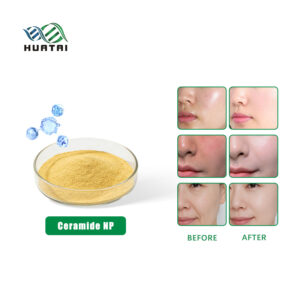
This is where Ceramide NP becomes relevant.
Rather than treating Ceramide NP as a standalone repair ingredient, formulators can consider its role within the broader lipid system of the finished product.
Ceramide NP as Part of a Barrier-Support Strategy
Ceramides are important components of the intercellular lipids in the stratum corneum. Together with cholesterol and free fatty acids, they contribute to the organization of the lipid matrix associated with skin-barrier function.
For cosmetic formulation, however, adding Ceramide NP is not equivalent to rebuilding the complete lipid structure of the natural stratum corneum. Its practical role depends on the surrounding formulation environment, including the other lipid components, their relative composition, physical state, and how the system is prepared.
This makes Ceramide NP different from a conventional brightening or anti-aging active. For many functional actives, formulation development may focus primarily on concentration, compatibility, delivery, or chemical stability. With Ceramide NP, the lipid system itself becomes part of the formulation consideration.
Why Ceramide NP Should Be Considered as a Lipid System
A practical approach is to evaluate Ceramide NP as one component of a broader lipid system rather than as an isolated ingredient. Ceramides, cholesterol, and free fatty acids are commonly considered together because their composition and organization are closely related to the barrier properties of the stratum corneum.
However, simply combining these lipid categories does not automatically reproduce the organization of skin lipids. The formulation still needs to provide a suitable physical environment for the lipid components. This means considering questions such as:
- What form of Ceramide NP is being used?
- How will it be dispersed or incorporated into the formulation?
- What other lipid components are present?
- Can the emulsion or delivery system maintain a stable lipid distribution?
- How will processing and cooling affect the final system?
These factors are part of what makes ceramide NP lipid system design different from simply adjusting the concentration of a conventional water-soluble active.
Ceramide NP Formulation: Raw Material and Processing Considerations
Ceramide NP has very low aqueous solubility, and its high molecular weight and chemical structure can make formulation more challenging than conventional water-soluble ingredients. Research on Ceramide NP-loaded liposomes, for example, has specifically identified poor aqueous solubility as a formulation challenge.
As a result, the physical form of the raw material matters. A powder, dispersion, pre-formulated lipid system, or other delivery format may require different incorporation procedures. The recommended phase, temperature, order of addition, and mixing conditions should therefore be evaluated before formulation trials are scaled up.
Processing can also influence the final distribution of the ceramide phase. In an emulsion, for example, the way Ceramide NP is introduced may affect whether it becomes adequately incorporated into the intended phase or remains poorly dispersed. Temperature and cooling conditions can also influence lipid organization and the physical stability of ceramide-containing systems.
For formulators, this makes the following information more useful than the INCI name alone:
In other words, the same Ceramide NP name does not provide enough information to predict the behavior of every commercial raw material in a finished product.
Does More Ceramide NP Mean Better Barrier Support?
Not necessarily.
Ceramide NP concentration is only one variable within the formulation. The performance of a ceramide-containing system depends on the composition and organization of the lipid phase, as well as the characteristics of the finished formulation. Increasing the amount of one lipid does not automatically result in a better-performing system.
There are also practical formulation limits. A higher lipid load can affect viscosity, texture, spreadability, emulsion stability, and overall sensory properties. For this reason, optimizing Ceramide NP should be considered together with the complete lipid system rather than as a concentration-only exercise.
For leave-on products intended for repeated application, the objective is not simply to maximize Ceramide NP content. The more practical goal is to develop a stable and cosmetically acceptable formulation in which the selected lipid components can function together.
Ceramide Structure Can Also Influence Formulation Performance
Although Ceramide NP is commonly identified by its subclass name, its molecular composition is not necessarily identical across all raw materials. Ceramide NP contains a phytosphingosine base linked to a non-hydroxy fatty acid, and differences in fatty-acid chain length can contribute to differences in ceramide structure.
Recent human data provide an additional reason to pay attention to this point. A 2026 intra-subject study compared formulations containing Ceramide NP with different acyl-chain profiles in 21 healthy young women. The formulation enriched in C24–C30 Ceramide NP produced greater improvements in barrier recovery, hydration, and stratum-corneum cohesion than the C18 Ceramide NP formulation tested in the study.
These findings are useful for ingredient evaluation, but they should not be interpreted as meaning that every longer-chain Ceramide NP material will perform better than every shorter-chain material. The study compared specific ceramide compositions in specific cream formulations, so chain length should be considered together with the overall ceramide composition and formulation system.
For raw-material selection, this reinforces a practical point: the specification behind the ingredient name can matter.
Ceramide NP in High-Active Skincare
The importance of barrier-supportive formulation strategies is particularly relevant to high-active skincare. A brightening serum, anti-aging cream, or multi-active treatment may contain several functional ingredients at the same time. The finished product therefore has to accommodate not only the intended active functions, but also factors such as solvents, emulsifiers, preservatives, pH, texture, and long-term physical stability.
Ceramide NP does not replace these active ingredients, and it should not be treated as a universal solution for formulation tolerance. Its role is different. It can be considered as part of the lipid-supporting side of the formulation, allowing skin-supportive components to be considered alongside high-performance actives.
This shifts the formulation question from:
“Which soothing ingredient should be added?”
toward:
“How should the overall system be designed for a high-active product intended for repeated use?”
This distinction is increasingly relevant as sensitive-skin considerations move beyond products specifically positioned for sensitive skin and become part of broader high-active formulation strategies.
What Should Formulators Evaluate?
When screening a Ceramide NP raw material for a new formulation, several practical questions are worth addressing:
| Evaluation Criterion | Practical Considerations |
|---|---|
| 1. What is the raw material form? | Powder, dispersion, or pre-formulated lipid system may require different processing approaches. |
| 2. What is the actual Ceramide NP specification? | Assay, chain-length profile, physical characteristics, and other supplier specifications can provide information that the INCI name alone cannot. |
| 3. How should it be incorporated? | The recommended phase, temperature, order of addition, and mixing conditions should be established before scale-up. |
| 4. What lipid components are used alongside it? | Ceramide NP should be evaluated within the intended lipid system rather than in isolation. |
| 5. Is the dispersion physically stable? | Sedimentation, aggregation, particle changes, viscosity shifts, and other physical changes should be monitored during stability testing. |
| 6. Does the lipid system affect the finished product? | Texture, spreadability, appearance, viscosity, and emulsion stability can all change when the lipid phase is modified. |
| 7. Is the final product suitable for repeated application? | For high-active skincare, skin comfort and sensory properties should be considered alongside the functional performance of the active system. |
The Practical Role of Ceramide NP
Ceramide NP is often discussed simply as a skin-barrier ingredient. For formulation development, however, its role is more useful when considered in the context of the entire lipid system.
The key questions are not limited to how much Ceramide NP to add. They also include: What form is being used? How is it dispersed? What lipid components surround it? How is the system processed? And does the final formulation remain stable and cosmetically acceptable?
This approach places Ceramide NP within the formulation architecture rather than treating it as another standalone soothing or repair active.
For high-active skincare, that distinction matters. Barrier-supportive components do not necessarily need to compete with functional actives for a place in the formula. They can instead be considered as part of the formulation framework designed to support a stable, usable product over repeated application.
References
- Schild M, et al. The role of ceramides in skin barrier function and the importance of their correct formulation for skincare applications. International Journal of Cosmetic Science, 2024.
- Gwon D-H, Choi H-K, Lee E-O, et al. Impact of Ceramide Acyl Chain Length on Human Skin Barrier Recovery and Hydration. Journal of Cosmetic Dermatology, 2026;25(3).
- The Design and Optimization of Ceramide NP-Loaded Liposomes to Restore the Skin Barrier. Pharmaceutics, 2023;15(12):2685.
- Kono T, et al. Clinical significance of the water retention and barrier function-improving capabilities of ceramide-containing formulations: A qualitative review. The Journal of Dermatology, 2021;48(12):1807–1816.

 English
  Spanish
  German
  French
  Japanese
  Korean