Naturium Tranexamic Topical Acid: A Formulator’s Deconstruction
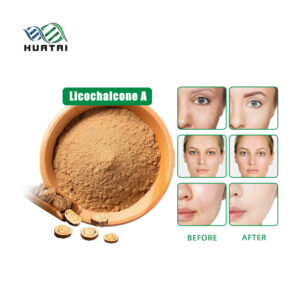
Look at Naturium’s 5% Tranexamic Acid serum. Most consumers see a dark spot fading product. I look at it and see a complex balancing act of chemical stability. They did not just dump 5% Tranexamic Acid (TXA) into water. They built a matrix. Tranexamic acid, kojic acid, niacinamide, and licorice root extract.
Brands constantly demand high percentages of single actives. They ignore the raw material grade. We see this fail in our labs every single week. You buy a cheap industrial grade of TXA. You mix it with botanical extracts. Your clear serum turns brown on the shelf in one month. You lose your customers.
The Real Science of TXA Quality
TXA does not inhibit tyrosinase directly like traditional brightening agents. It operates upstream. It blocks the conversion of plasminogen to plasmin. Less plasmin means keratinocytes release less arachidonic acid. This directly cuts off the inflammatory signal that tells your melanocytes to produce excess pigment after UV exposure. It is a pathway interceptor.
But TXA itself is a synthetic amino acid derivative. Structurally, it is extremely stable to heat and light. A common misconception among junior formulators is that TXA degrades easily. It does not. The danger lies in its impurities.
Standard industrial TXA contains trace heavy metals. Iron is the absolute enemy of a synergistic formula. Think about the Naturium product again. It contains Kojic Acid and Licorice Root. Both are rich in phenolic compounds. When iron molecules from cheap TXA meet phenolic compounds, they form a highly colored complex. Your product oxidizes rapidly.
Here is the specification baseline you actually need for a stable cosmetic formula:
| Parameter | Standard Market Grade | Premium Cosmetic Grade | Formulator Impact |
|---|---|---|---|
| Purity (Assay) | ≥ 98.0% | ≥ 99.5% | Guarantees batch efficacy |
| Appearance | White crystalline powder | Pure white crystalline powder | Ensures aesthetic clarity |
| Heavy Metals (Pb) | < 20 ppm | < 5 ppm | Prevents cross-reactions |
| Iron (Fe) | < 15 ppm | < 2 ppm | Stops phenolic oxidation and browning |
Lab Failure Case Study: The Catalyst Effect
Let me share a real lab failure to prove this.
A client sent us their failing prototype last year. It was a 5% TXA + 1% Kojic Acid serum. It turned deep yellow after just four weeks in their 40°C accelerated stability oven. Their formulator thought the heat destroyed the TXA. Wrong.
We ran a liquid chromatography (HPLC) analysis on their degraded sample. The TXA concentration was still perfectly intact at 4.98%. But the Kojic Acid had oxidized entirely, dropping to 0.42%. We investigated their supply chain. The cheap TXA they sourced had 18 ppm of iron. That iron acted as a catalyst, accelerating the Kojic acid degradation.
We reformulated their product immediately. We swapped in our premium cosmetic-grade TXA with iron levels heavily controlled below 2 ppm. We added 0.1% Disodium EDTA to scavenge any remaining free metal ions. Look at the difference in our 12-week accelerated stability data (40°C).
| Formula Variation | TXA Retention (12 Weeks) | Kojic Acid Retention | Visual Color Shift |
|---|---|---|---|
| Client Original Formula | 99.6% | 42.0% | Deep Yellow / Brown |
| Our Optimized Formula | 99.8% | 96.5% | Pale Straw (Acceptable) |
The pH Trap and Regulatory Ceilings
You also must manage the pH drift. Naturium combines TXA with Niacinamide. This is a brilliant efficacy combination, but a formulation hazard. TXA naturally drives the pH of a water solution slightly alkaline (around 7.5). Niacinamide hydrolyzes into nicotinic acid if the pH drops too low or goes too high, causing skin flushing.
You must buffer this specific combination tightly between pH 5.5 and 6.5. You add the TXA into the water phase first. It dissolves instantly. Then you adjust the pH down with a mild acid like citric acid before adding your heat-sensitive co-actives.
Let’s discuss regulatory reality. Pushing 5% TXA is highly popular in the US market. Naturium proved consumers want it. But it creates borderline regulatory issues elsewhere. Japan’s Ministry of Health, Labour and Welfare (MHLW) strictly classifies TXA as a quasi-drug active for whitening. You must control your manufacturing process strictly to meet their purity standards. If you formulate for global distribution, a 2% to 3% concentration combined with secondary brightening agents often hits the exact same efficacy endpoints without triggering drug classifications in strict markets.
Verified COA Standards
We supply this ultra-pure grade of TXA to brands globally. You need a reliable Certificate of Analysis (COA) to pass your cosmetic safety assessments.
| COA Test Item | Specification Limits | Typical Batch Result | Test Method |
|---|---|---|---|
| Assay (Dry basis) | 99.0% – 101.0% | 99.8% | Titration |
| Loss on Drying | ≤ 0.5% | 0.12% | Pharmacopoeia |
| Iron (Fe) | ≤ 10 ppm | 1.5 ppm | Atomic Absorption |
| Total Plate Count | < 100 cfu/g | < 10 cfu/g | USP <61> |
Stop formulating blindly. Purity dictates shelf life. Use chelators. Control your pH strictly when combining with Niacinamide. Understand your active’s real chemical weaknesses before scaling up production. We can provide sample materials for your next R&D project. Test our high-purity material against your current supplier in a heat stability oven. The chemical difference will be obvious in exactly four weeks.
References Used:
- Mechanism of Action of Tranexamic Acid in the Treatment of Melasma. (Dermatologic Therapy, 2022).
- Stability and Degradation Kinetics of Kojic Acid in Cosmetic Emulsions. (Journal of Cosmetic Science, 2021).
- Regulatory Guidelines for Quasi-Drug Actives in Japan (Ministry of Health, Labour and Welfare, 2023).
- Interactions Between Niacinamide and pH in Cosmetic Formulations. (International Journal of Pharmaceutics, 2020).
For Bulk Sourcing, Quotations, or Sample Requests:
🔒 Get Your Technical Dossier: Access TDS, MSDS, COA, and Clinical Efficacy Reports.
🔬 Apply for a Free Sample: Test the superior efficacy and purity of active skincare ingredients today.
📞 Get a Customized Quote: Discuss bulk orders and high-purity specifications.
Email: [email protected]
Why choose us
Natural huatai provides a comprehensive portfolio of high-efficacy cosmetic active ingredients, empowering global brands to create next-generation skincare formulations tailored for the high-end market. We combine nature’s potency with scientific precision to meet your most demanding formulation needs.
Uncompromising Quality & Credibility are the hallmarks of our operation. We ensure every batch of our Active skincare ingredients meets rigorous international quality standards, supported by a complete Technical Dossier. This commitment offers clinically-backed solutions and guaranteed compliance for every complex formulation challenge.
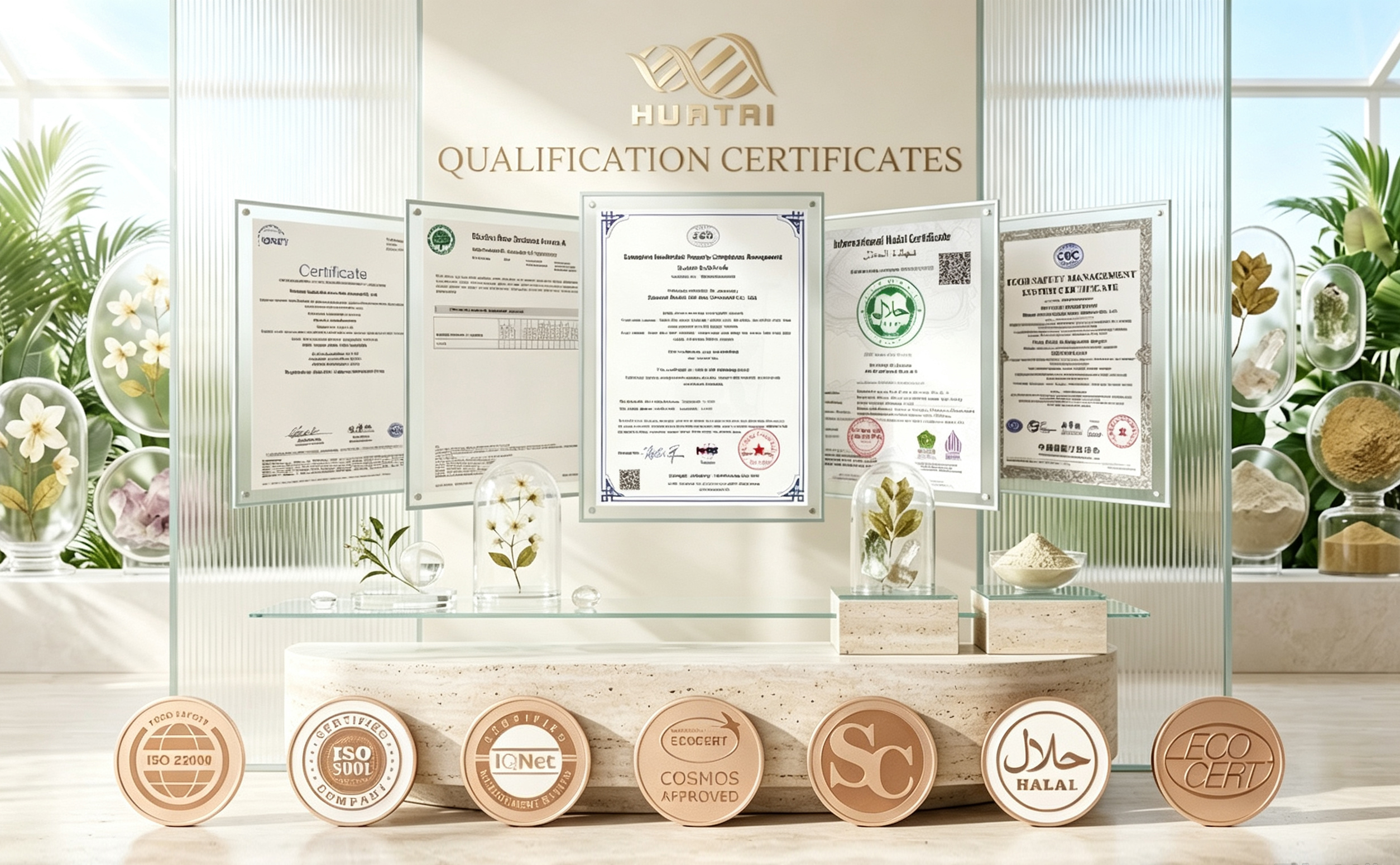
Certified Excellence & Supply Chain Integrity define our reliability as a premier partner. Our facilities and products are strictly verified by global standards, including COSMOS, ISO 9001/22000, and HALAL. We maintain full transparency across our entire supply chain, providing a safe and world-class foundation for your beauty innovations.
Driving Sustainable Innovation is our vision for the future of conscious beauty. By integrating green chemistry and eco-friendly sourcing into our R&D processes, we deliver ingredients that harmonize performance with environmental responsibility. We strive to be your strategic partner in co-creating ethical and transformative skincare experiences.
 English
  Spanish
  German
  French
  Japanese
  Korean