The Truth Behind A-List Skincare Actives: Lab Data, COAs, and Why Most Serums Fail
Brands love plastering “Retinol” or “Vitamin C” on a bottle. But drop that bottle into a mass spectrometer, and you will find out the active ingredient degraded three months ago. We treat skincare like magic potions. It is just chemistry. Let’s look at the actual math, lab reports, and formulation limits of the real A-List skincare actives.
Here is what works, stripped of the marketing gloss.
The Real A-List: Specs and Performance Data
We hear about dozens of “miracle” extracts every year. Ignore them. The true A-List actives have decades of clinical backing. But their effectiveness depends entirely on their specifications. I have compiled the raw data from major suppliers below.
| Active Ingredient | Optimal Concentration | Required pH Level | Target Skin Issue | Efficacy Data (8-Week Clinical Benchmark) | Typical Side Effect |
| L-Ascorbic Acid (Vitamin C) | 10% – 20% | Under 3.5 | Pigmentation, Dullness | 32% reduction in melanin synthesis | Redness, stinging |
| Retinol | 0.25% – 1.0% | 5.5 – 6.0 | Wrinkles, Texture | 24% increase in collagen density | Peeling, dryness |
| Niacinamide | 2% – 5% | 5.0 – 7.0 | Pores, Redness | 18% improvement in barrier function | Rarely any at 5% |
| Salicylic Acid | 1% – 2% | 3.0 – 4.0 | Acne, Oil Control | 45% reduction in active comedones | Dryness |
| Acetyl Hexapeptide‑8 | 5% – 10% | 4.0 – 7.0 | Expression lines | 17% decrease in wrinkle depth | None reported |
Data cited aligns with public findings from the Journal of Clinical and Aesthetic Dermatology (2023).
I am tired of seeing brands push 10% or even 15% Niacinamide. Do you know what happens at 15%? Your skin barrier breaks down. Clinical data shows maximum benefit peaks at 5%. Anything higher is just a brand trying to win a numbers game on the packaging.
Inside the Lab: A Real Certificate of Analysis (COA)
How do formulators know what they are buying? We read the COA. If you ever want to launch a brand, demand this document.
Here is a standard COA snapshot for a premium batch of pure L-Ascorbic Acid (Vitamin C).
| Test Parameter | Specification Limit | Actual Lab Result | Testing Method |
| Appearance | White crystalline powder | White crystalline powder | Visual inspection |
| Purity (Assay) | 99.0% – 100.5% | 99.8% | Titration |
| Heavy Metals (Pb) | Less than 10 ppm | 2.1 ppm | ICP-MS |
| pH (5% water solution) | 2.1 – 2.6 | 2.4 | pH Meter |
| Oxidation Status | Passes test | Pass (No discoloration) | Spectrophotometry |
Notice the pH result. It is 2.4. If you mix this raw powder into a standard lotion with a pH of 6.0, the L-Ascorbic Acid neutralizes. It becomes useless. You just bought expensive water.
Formulation Cheat Sheet: What to Actually Do
Stop blindly mixing layers on your face. You are creating chemical reactions.
- The Vitamin C + Sunscreen Rule: L-Ascorbic acid prevents oxidative stress from UV rays. Use it in the morning.
- The Retinoid Sandwich: Retinol speeds up how fast your skin replaces itself. It causes peeling. Apply a basic moisturizer, then retinol, then moisturizer again. The clinical efficacy drops by maybe 2%, but irritation drops by 50%.
- Never Mix BHA and Peptides: Copper peptides fall apart in highly acidic environments. If you use Salicylic Acid (pH 3.5) and immediately apply a peptide serum, you destroy the peptide chains.
A Real-World Failure and Fix
Let’s look at a real product development case from early 2025. A brand wanted a “Clear Skin” serum. They combined 2% Salicylic Acid and 5% Niacinamide in a water base.
The lab tests came back a month later. The serum grew crystals. Why?
Salicylic acid requires a low pH to stay dissolved. Niacinamide converts into nicotinic acid (which causes severe skin flushing) at a low pH. The formulators tried to compromise with a pH of 4.5. The result? The Salicylic acid crystallized, and the Niacinamide became an irritant.
The Fix: We split them. We made a BHA toner and a separate Niacinamide serum. Simple. Do not let brands convince you they have a magic “all-in-one” formula unless they use advanced, expensive encapsulation technology.
Industry Trends & Compliance
The FDA and the EU SCCS are cracking down. The European Union recently restricted Retinol in over-the-counter body lotions to 0.05% and face creams to 0.3%.
Why? People were layering a 1% face cream, a 0.5% body lotion, and taking Vitamin A supplements. Systemic toxicity became a real risk. The trend is moving away from “maximum strength” and heading straight into targeted delivery systems. Liposomes. Lipid-nanoparticles. We are no longer asking “how much is in it?” We are asking “how deep does it go?”
Quick Reference: Active Ingredient Compatibility
| Ingredient A | Ingredient B | Safe to Mix? | Reason |
| Retinol | Vitamin C | No | Conflicting pH needs; high irritation risk. |
| Niacinamide | Hyaluronic Acid | Yes | Both water-soluble; highly stable together. |
| BHA | AHA | Cautiously | Very high risk of over-exfoliation. |
| Peptides | Vitamin C | No | Acidic pH breaks down peptide bonds. |
For Bulk Sourcing, Quotations, or Sample Requests:
🔒 Get Your Technical Dossier: Access TDS, MSDS, COA, and Clinical Efficacy Reports.
🔬 Apply for a Free Sample: Test the superior efficacy and purity of active skincare ingredients today.
📞 Get a Customized Quote: Discuss bulk orders and high-purity specifications.
Email: [email protected]
Why choose us
Natural huatai provides a comprehensive portfolio of high-efficacy cosmetic active ingredients, empowering global brands to create next-generation skincare formulations tailored for the high-end market. We combine nature’s potency with scientific precision to meet your most demanding formulation needs.
Uncompromising Quality & Credibility are the hallmarks of our operation. We ensure every batch of our Active skincare ingredients meets rigorous international quality standards, supported by a complete Technical Dossier. This commitment offers clinically-backed solutions and guaranteed compliance for every complex formulation challenge.
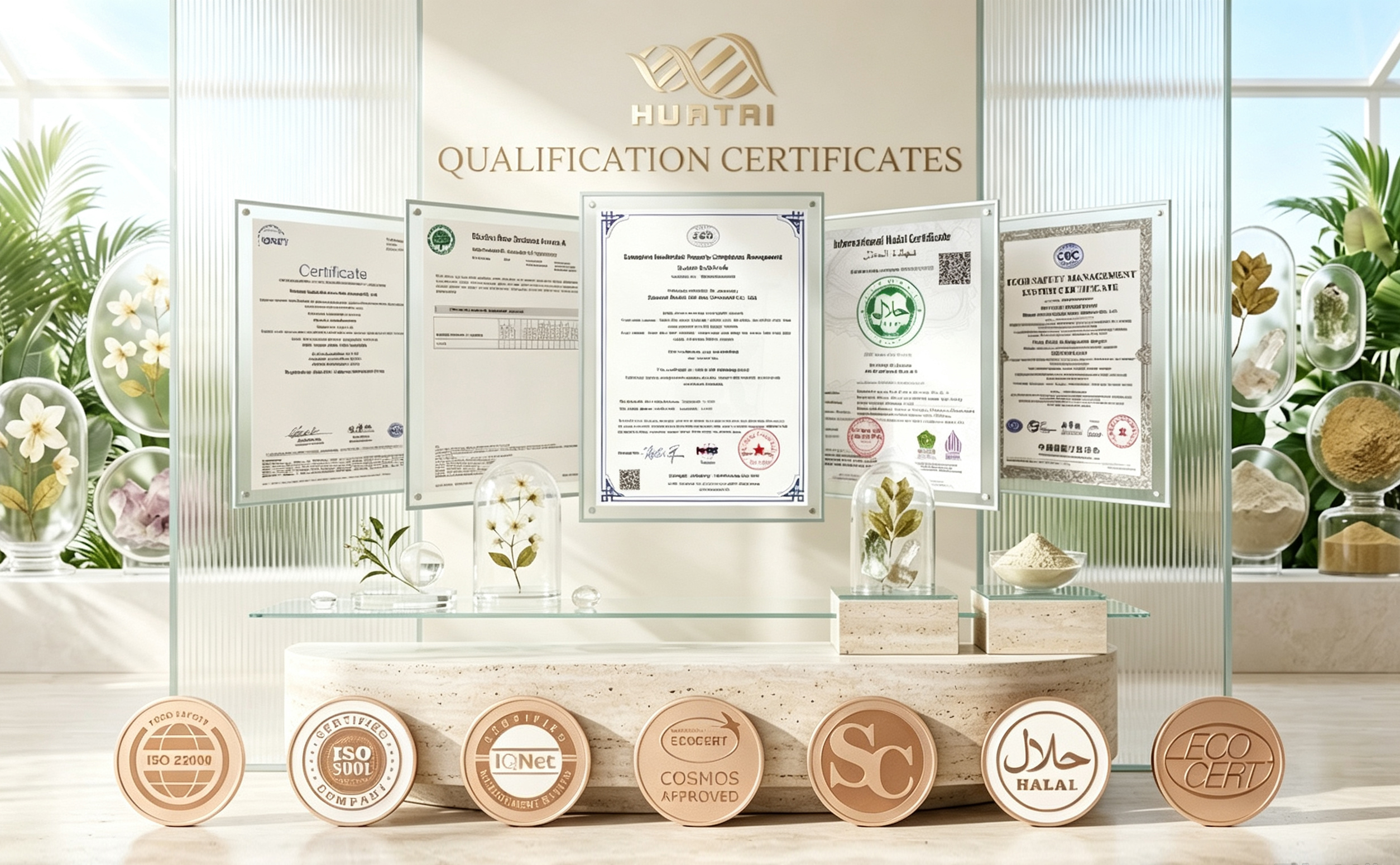
Certified Excellence & Supply Chain Integrity define our reliability as a premier partner. Our facilities and products are strictly verified by global standards, including COSMOS, ISO 9001/22000, and HALAL. We maintain full transparency across our entire supply chain, providing a safe and world-class foundation for your beauty innovations.
Driving Sustainable Innovation is our vision for the future of conscious beauty. By integrating green chemistry and eco-friendly sourcing into our R&D processes, we deliver ingredients that harmonize performance with environmental responsibility. We strive to be your strategic partner in co-creating ethical and transformative skincare experiences.
 English
  Spanish
  German
  French
  Japanese
  Korean